
Retirement
Planning
Strategies
Why Retirement Planning Matters
Retirement planning entails making intentional choices today so you can enjoy financial security later. With retirement lasting decades, relying solely on Social Security won’t cut it. To support your retirement needs, you need to build your own savings. Doing so will give you independence, peace of mind, and the freedom to pursue your goals.
39%
workers lack confidence due to insufficient savings
According to the 2024 Retirement Confidence Survey by the Employee Benefit Research Institute, 39% of workers who lack confidence in their retirement prospects cite insufficient savings as their primary concern. Further, many retirees say they would make different decisions if they could go back, especially regarding taxes, expenses, and timing.
Before we do a deep dive, let’s first discuss some of the core retirement planning strategies that can serve as a solid foundation for your retirement needs.
Choosing the Right Retirement Strategy for Your Risk Profile
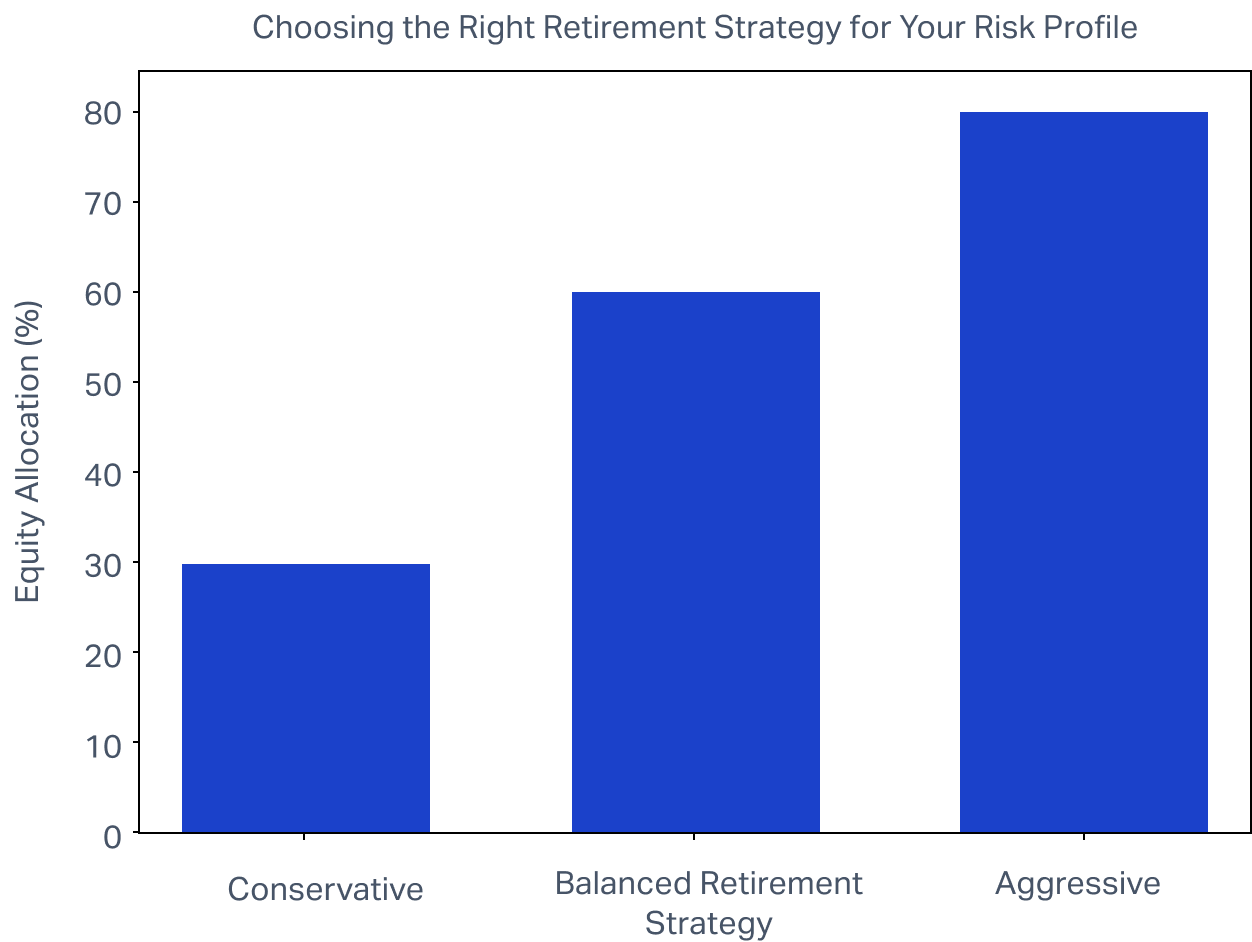
Conservative Strategy
A conservative strategy focuses on capital preservation and sustaining a stable income during your retirement years.
- Higher allocation to bonds, U.S. Treasuries, cash, and income-generating assets
- Lower exposure to equities
- Designed to reduce volatility and protect against major losses
Suitable for: This strategy is a good fit for retirees with low-risk tolerance or who rely heavily on portfolio income. The trade-off here is lower growth potential, which may leave you vulnerable to higher inflation risk over a longer retirement.
Balanced Strategy
A balanced strategy combines growth and income.
- Moderate mix of stocks and bonds, such as a 50/50 or 60/40 allocation in favor of equities.
- Seeks steady growth while managing volatility
Suitable for: This approach is beneficial for retirees who need income but also want their portfolios to outpace inflation. The trade-off here is limited exposure to market downturns, but comparatively lesser volatility than aggressive portfolios
Aggressive Strategy
An aggressive strategy prioritizes long-term growth over short-term stability.
- Higher allocation to equities, such as 70 to 85% allocation to stocks
- Designed to combat inflation and support longer retirement horizons
Suitable for: An aggressive retirement strategy is often adopted by early retirees or those with strong guaranteed income sources, such as Social Security. These folks have a higher tolerance for market volatility. The trade-off here is greater short-term volatility along with the potential for significant market swings.
Now, let’s move on to how you should go about allocating your assets for retirement.
Find & Compare Top Financial
Advisors in Your Area
Get Started
A better way to find the right financial advisor
Designing Your Retirement Asset Allocation Strategy
Each asset class has a different risk-to-reward ratio and plays a specific role in your portfolio. Choosing the right mix of asset classes helps optimize returns, diversify risk, ensure your portfolio meets specific financial objectives, and more.
Stocks generally offer higher growth potential but are more volatile. This makes them ideal for investors with a longer time horizon and higher risk tolerance. Bonds provide stability and regular income, helping to balance the riskier assets. ETFs can give you diversified exposure to various sectors or markets, while real estate often acts as a hedge against inflation and can provide steady returns.
You may choose:
Here, you gradually lower your stock exposure as you age, for example, a 60/40 mix or “110 minus age” in equities, thereby lowering portfolio volatility. This strategy is simple and easy to adopt, though it does not account for personal factors, such as guaranteed income, health, longevity expectations, or risk tolerance. In age-based allocation, younger retirees have a higher tolerance for market volatility, while older retirees tend to lean toward capital preservation.
This strategy promotes diversification and long-term portfolio growth. It maintains a diversified mix of stocks and bonds, focusing on systematic withdrawals of 3 to 4% from the portfolio's overall returns. The one major drawback of this strategy is that you need to be a disciplined investor during downturns to avoid overspending when markets decline.
Here, you gradually lower your stock exposure as you age, for example, a 60/40 mix or “110 minus age” in equities, thereby lowering portfolio volatility. This strategy is simple and easy to adopt, though it does not account for personal factors, such as guaranteed income, health, longevity expectations, or risk tolerance. In age-based allocation, younger retirees have a higher tolerance for market volatility, while older retirees tend to lean toward capital preservation.
By separating funds, retirees can manage sequence-of-returns risk and lower the need to sell stocks during market downturns. Though the bucket strategy offers clarity of spending, you would have to rebalance between buckets from time to time.
Now let’s find out how you can lower those pesky taxes during retirement.
I Want to Take Charge.
Help me find and compare top vetted
financial advisors in my area.
FINRA/SEC Registered Advisors
 Your Information is Safe and Secure
Building a Tax-Efficient Retirement Income Plan
Each asset class has a different risk-to-reward ratio and plays a specific role in your portfolio. Choosing the right mix of asset classes helps optimize returns, diversify risk, ensure your portfolio meets specific financial objectives, and more.
Stocks generally offer higher growth potential but are more volatile. This makes them ideal for investors with a longer time horizon and higher risk tolerance. Bonds provide stability and regular income, helping to balance the riskier assets. ETFs can give you diversified exposure to various sectors or markets, while real estate often acts as a hedge against inflation and can provide steady returns.
You may choose:
1
Start by spreading your money across taxable, tax-deferred (401(k) and traditional IRA), and tax-free (Roth) accounts to manage income in retirement. Doing so affords you the flexibility to control how much taxable income you generate each year in retirement.
2
Next, sequence your withdrawals carefully. Ensure you withdraw from taxable accounts first, then from tax-deferred accounts, and lastly from the Roth account. Adopting this approach lowers your total lifetime tax liability.
3
In between all this, don’t forget to plan ahead for RMDs! According to the Internal Revenue Service (IRS), retirees must begin taking their RMDs at age 73; failing to do so may result in a penalty. Ensure you time your withdrawals so you do not get pushed into a higher tax bracket.
4
Coming to capital gains, you can offset them or lower up to $3,000 of ordinary income annually by using tax-loss harvesting. You may also delay taking your Social Security benefits (up to age 70) to boost your retirement income.
5
You may also incorporate an estate tax plan in your retirement strategy to lower the tax burden for your heirs and preserve more of your wealth for the next generation.
Now that you’ve ironed out a plan to tackle your taxes, we finally come to diversification and why it is pivotal for a secure retirement.
Why Diversification Matters in Your Retirement Portfolio
Don’t put all your money in one place. Spread your investments across different asset classes, such as stocks, bonds, cash, and other assets, and further diversify within each category. Doing so will help you avoid relying on a single investment’s performance. Diversification helps cushion losses during market downturns and creates more stable long-term outcomes, allowing you to balance growth and stability in changing market conditions.
Retirement Income Calculator see how long your savings last
Calculate NowBuilding a Secure Retirement
Understand that the journey towards retirement is not a static path. You have to continuously save, invest, and reflect to ensure you are on the right track. How well you’ve planned can make all the difference in whether you live comfortably in retirement. A financial advisor’s input can be instrumental in fine-tuning your retirement strategy and helping you reach a secure retirement.
Frequently Asked Questions
WiserAdvisor.com, founded in 1998, is an independent financial advisor matching service designed to help match individuals to vetted financial advisors who are aligned with their specific needs. Financial services covered by the advisors include financial planning, portfolio management, wealth management, retirement planning, educational planning, estate planning, and business finances. We pride ourselves on our system's simplicity, objectivity, and our network of pre-screened advisors. Within five minutes you can be on your way toward finding an advisor who can work towards your goals, at no cost or obligation to you.
We offer 2 great ways to find an advisor. In each case, the system has been designed to cut through the complexity of searching for a financial advisor and to point you directly to vetted advisors suited to your financial needs. We have spent over twenty years developing and enhancing the service to make sure that WiserAdvisor.com is the only tool you will need to use to find a suitable advisor. The easiest way to get started is directly from the home page.
In order for a person to take control of their financial future, three things are required: interest, skill, and time. Some individuals are not interested in managing their money, planning for retirement, doing their taxes or preparing for the education of their children themselves. Others may feel that they don't have the necessary skills to navigate the complexities of finances and investing, or simply don't have the time. If you fall into one or more of these categories, a financial professional can help you to prepare for retirement or other life changes, avoid costly mistakes, and sleep soundly at night. For a more detailed description of how to determine if you would benefit from a financial professional, please click here.
Professional financial help is no longer considered a service for the wealthy. Help is available for individuals at every income level. While some companies have a minimum portfolio size or net worth requirements, there are many opportunities for those who are just getting started. Advisors are looking to build long-lasting relationships that may start out small but eventually grow with time.
Related Guide